Chia seeds and tukh malanga (basil seeds) look almost identical once they hit a glass of water — both turn into small, jelly-coated seeds that people spoon into summer drinks, smoothies and desserts. But they are two different plants, with different sizes, different textures, and slightly different traditional uses in Pakistani kitchens. This guide breaks down exactly how chia seeds and tukh malanga differ, so you know which one to reach for — or whether to just keep both in your pantry.
- What is Chia Seeds?
- What is Tukh Malanga?
- Nutrition: What’s Actually in Each Seed
- Chia Seeds vs Tukh Malanga: Side-by-Side Comparison
- Benefits of Each Seed
- How to Use Chia Seeds and Tukh Malanga
- Buying Guide: What to Look For
- Storage & Shelf Life
- Who Should Be Careful
- Chia Seeds aur Tukh Malanga ke Fayde
- Frequently Asked Questions
What is Chia Seeds?
Chia seeds come from the Salvia hispanica plant, a flowering herb originally from Mexico and Guatemala, and sold today in Pakistan as a health-food staple. Be Natural Chia Seeds are raw, cleaned seeds with nothing else added — no roasting, no salt, no fillers. In their dry form, chia seeds are small, oval and speckled grey-black, slightly larger and flatter than tukh malanga.
What makes chia seeds popular worldwide — and the reason they show up in so many “superfood” lists — is what happens when you soak them. Each seed is covered in a layer of soluble fibre that absorbs roughly ten times its own weight in liquid, forming a thick, pudding-like gel. That single property is behind almost every way people use chia seeds: as a thickener for drinks, a base for chia pudding, or an egg substitute in baking.
In English, the product is simply called “chia seeds” — there isn’t a widely used separate Urdu name the way there is for tukh malanga (sabja/tukhm-e-rehan) or isabgol (ispaghol). Most Pakistani shoppers search for and buy it as “chia seeds” directly, which is also why “chia seeds” alone is one of the highest-searched health-food terms in the country.
What is Tukh Malanga?
Tukh malanga (تخم ملنگا) — also called basil seeds, sabja, or tukhm-e-rehan — are the seeds of a basil variety (Ocimum basilicum), and they’ve been part of Pakistani summers for generations, long before chia seeds arrived in local shops. Be Natural Tukh Malanga is 100% pure, with nothing added. Dry, the seeds are small, fully black, and rounder than chia — you can usually tell the two apart by eye once you’ve seen them side by side (see the comparison images further down).
Like chia, tukh malanga seeds are covered in mucilage — a soluble fibre layer that swells into a soft, slippery gel coating when soaked in water, usually within 10 to 15 minutes, a little faster than chia. The classic use in Pakistan is in sharbat: tukh malanga stirred into chilled lemonade, rooh afza, or milk for a cooling summer drink, and it’s a familiar ingredient in falooda.
If you’ve searched “tukh malanga in english,” the answer is basil seeds (sometimes written sweet basil seeds). Read the full guide on Tukh Malanga in English: What It Is, Benefits & How to Use for a deeper look at this product on its own.
Nutrition: What’s Actually in Each Seed
Both seeds are natural sources of soluble fibre, which is the main reason people add either one to water or a smoothie — fibre is what keeps you feeling full for longer and supports regular digestion. Beyond fibre, the two differ a little:
- Chia seeds are a well-known plant source of omega-3 fatty acids, along with protein and calcium. This is the single biggest nutritional difference between the two — chia’s omega-3 content is why it’s marketed internationally as a “superfood,” and it’s the main reason health-conscious buyers specifically search for chia over other swelling seeds.
- Tukh malanga is valued mainly for its fibre and its traditional cooling effect in hot weather, rather than being promoted for omega-3 content. It has a longer history in South Asian households as a heat-season drink ingredient.
Neither seed should be treated as a stand-alone meal replacement or medicine — think of both as a simple way to add fibre to your day, the same way you’d add any wholegrain or seed to a meal. A useful way to think about the difference: if your goal is specifically weight management and daily fibre with an omega-3 boost, chia seeds are usually the stronger pick; if you’re after a cooling, traditional drink ingredient for hot weather, tukh malanga is the more familiar choice.
Chia Seeds vs Tukh Malanga: Side-by-Side Comparison
This is the question most people are actually asking when they search “difference between chia seeds and tukh malanga” or “is tukh malanga the same as chia seeds” — and the short answer is no, they are two different plants. Here’s the comparison at a glance:
| Chia Seeds | Tukh Malanga (Basil Seeds) | |
|---|---|---|
| Plant source | Salvia hispanica (a mint-family herb, from Mexico/Guatemala) | Ocimum basilicum (a basil variety, long-used in South Asia) |
| Dry appearance | Larger, oval, grey-black speckled | Smaller, round, fully black |
| Swells in | About 15 minutes in water | About 10-15 minutes in water (slightly faster) |
| Texture when soaked | Thick, pudding-like gel | Softer, slippery jelly coating |
| Best known for | Fibre, plant omega-3, protein | Fibre, traditional cooling effect in summer |
| Classic Pakistani use | Smoothies, chia pudding, overnight oats | Sharbat, lemonade, rooh afza, falooda |
| Taste | Almost neutral, slightly nutty | Neutral, very mild |
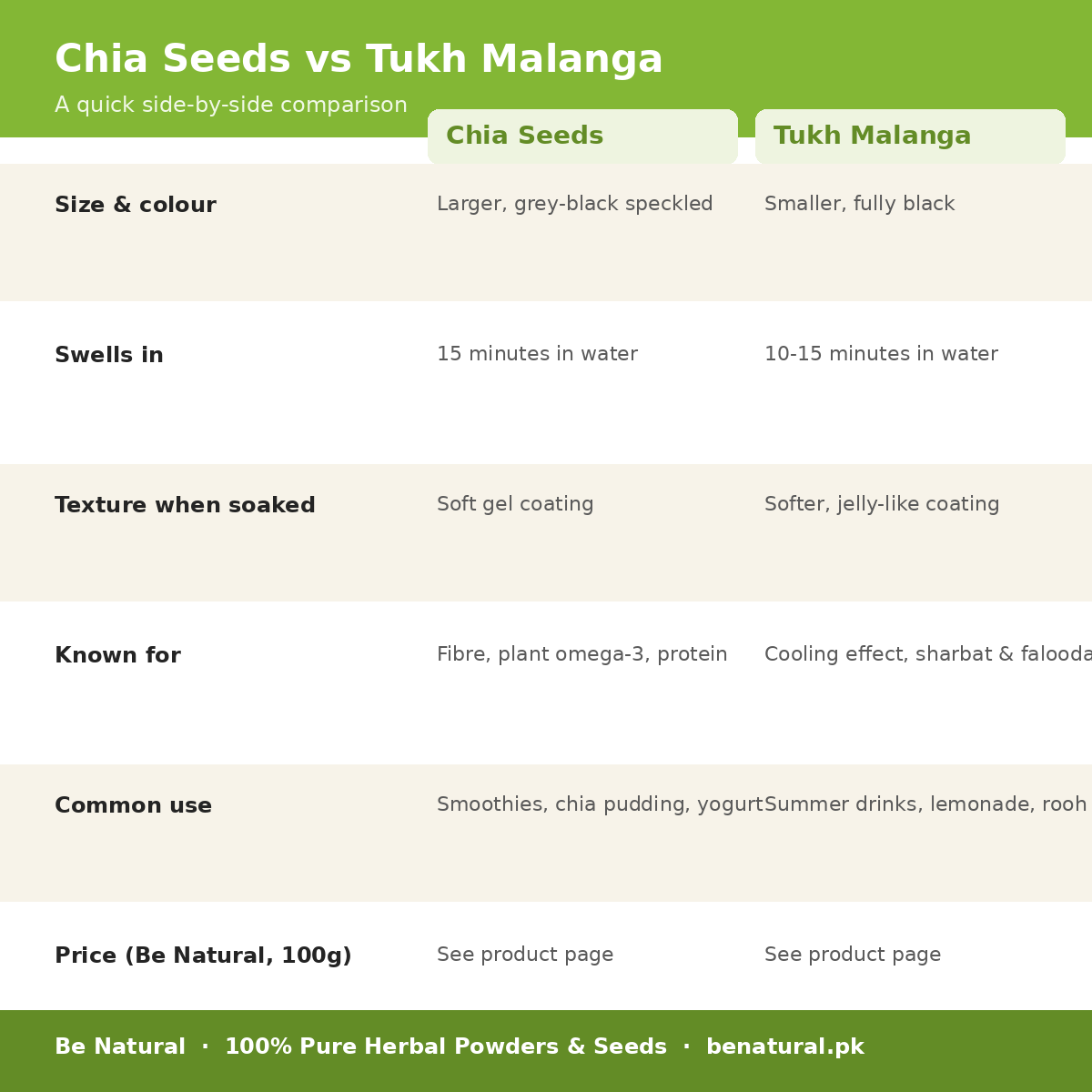
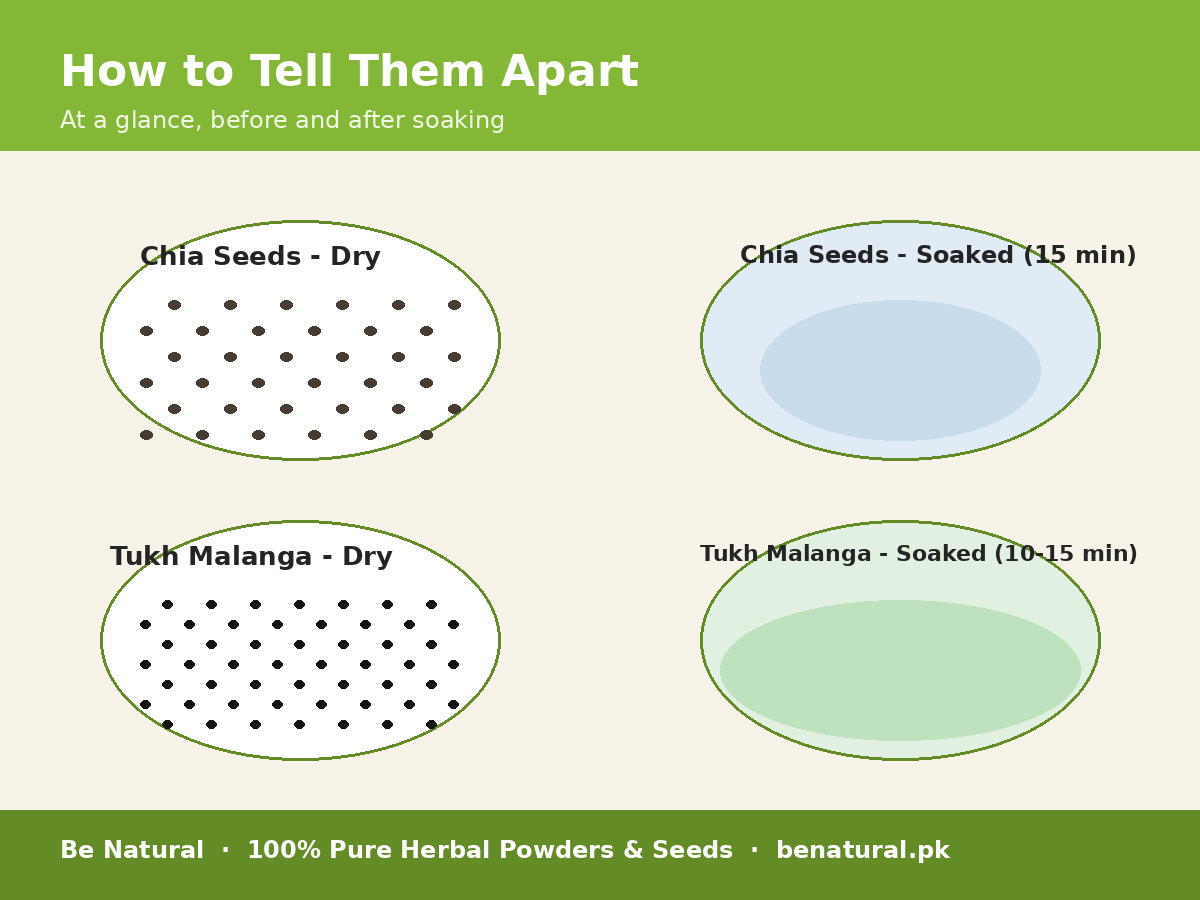
The easiest way to tell them apart with your own eyes — before and after soaking — is shown below. Chia seeds stay slightly larger and keep a speckled look even once gelled, while tukh malanga turns a more uniform, deep jelly.
Which One Should You Choose?
If you’re asking which one is “better,” the honest answer is that they’re not competing for the same job. Chia seeds are the better pick if you specifically want omega-3 and protein alongside fibre, and you’re using them in smoothies, overnight oats or chia pudding — recipes where a thicker, pudding-like gel works best. Tukh malanga is the better pick for a classic Pakistani summer drink, sharbat or falooda, where a lighter, faster-forming jelly and a neutral taste suit the recipe better, and it’s traditionally the seed reached for to cool down in hot weather.
Price and availability matter too. Tukh malanga has a longer history in local kitchens and is often the more familiar, lower-cost option for everyday sharbat, while chia seeds are the one most people specifically search for when they want the omega-3 and weight-management angle. There’s no rule against keeping both in your pantry — many Be Natural customers order one of each and use them for different things through the week.
Benefits of Each Seed
Chia Seeds Benefits
- A natural source of fibre, which helps you feel full for longer
- A plant-based source of omega-3 fatty acids
- Contains protein and calcium
- Easy to add to a weight-management routine as part of a balanced diet
- Forms a gel that works as an egg substitute in some baking recipes
Tukh Malanga Benefits
- A natural source of fibre
- Traditionally used as a cooling ingredient in Pakistan’s hot summer months
- Keeps you feeling full for longer, which is why it’s often added to a weight-management diet
- Easy to prepare — swells faster than chia seeds
- A familiar, mild-tasting addition to sharbat, lemonade and falooda
Neither seed “cures” or “treats” any condition — both are traditional, natural additions to food and drink, not medicine. If you want a deeper look at using chia seeds specifically for weight management, see our dedicated Chia Seeds product page, which covers portion sizes and daily use.
How to Use Chia Seeds and Tukh Malanga
Both seeds follow the same basic rule: always soak before eating. Dry, unsoaked seeds can absorb water in your throat, which is uncomfortable and, for small children, a genuine choking risk — see the caution section further down.
- Add 1 tablespoon of chia seeds, or 1 teaspoon of tukh malanga, to a full glass of water.
- Stir well so the seeds don’t clump together.
- Let chia seeds sit for about 15 minutes, and tukh malanga for 10-15 minutes, until fully gelled.
- Stir again before drinking or adding to food — a quick stir breaks up any remaining clumps.
Classic Tukh Malanga Sharbat
Soak 1 teaspoon of tukh malanga in a little water for 10-15 minutes. Mix a glass of chilled lemonade or rooh afza, then stir in the soaked seeds. Add ice and serve immediately — this is the everyday summer drink found in most Pakistani homes.
Overnight Chia Pudding
Mix 3 tablespoons of chia seeds into a cup of milk (dairy or plant-based) with a little honey. Stir well, cover, and refrigerate overnight. By morning it sets into a thick pudding — top with fruit before eating.
Falooda with Tukh Malanga
Soak 1 teaspoon of tukh malanga until gelled. Layer it in a tall glass with falooda sev (vermicelli), a scoop of kulfi or ice cream, and rooh afza syrup. A small spoon of soaked chia seeds can be layered in too, for extra texture.
Mixed-Seed Smoothie
Blend yogurt, a banana, and a little honey, then stir in 1 tablespoon of soaked chia seeds (or tukh malanga, or both) at the end rather than blending them in — this keeps their texture rather than pulverising it.
Detox-Style Infused Water
Soak 1 teaspoon of either seed in a large jug of water with a few slices of lemon and mint leaves. Refrigerate for an hour before drinking. This is a simple way to sip fibre-rich water through the day without any added sugar, and works well as a between-meals habit alongside a balanced diet.
Buying Guide: What to Look For
Whichever seed you’re buying, check for the same basics: the seeds should be dry, loose and free-flowing (not clumped or damp), with a consistent colour and no musty smell. Chia seeds should show a clean grey-black speckle, not a dull or faded colour. Tukh malanga should be a uniform, deep black — a patchy or brownish batch usually means it’s old stock. Packaging should be sealed and airtight, not an open scoop-bin that’s been exposed to air and moisture.
Be Natural sells both as raw, 100% pure 100g packs with nothing added — no roasting, no added flavour, no fillers — packed for Cash on Delivery all over Pakistan. A 100g pack of either seed goes a long way, since a single serving is only 1 teaspoon to 1 tablespoon at a time, so one pack typically lasts several weeks of regular use.
Storage & Shelf Life
Keep both chia seeds and tukh malanga in an airtight container, in a cool, dry place away from direct sunlight and moisture. Stored this way, dry seeds keep well for many months. Once soaked, don’t store the gelled mixture for more than a day in the fridge — make fresh batches for drinks and recipes.
Who Should Be Careful
Always soak chia seeds and tukh malanga before eating — never give either to small children dry, since dry seeds can swell in the throat and become a choking hazard. Drink plenty of water alongside both. If you’re pregnant, breastfeeding, or managing a medical condition, it’s a good idea to check with your doctor before adding a new seed to your daily diet in larger amounts, the same general caution that applies to any new fibre-rich food.
Chia Seeds aur Tukh Malanga ke Fayde
Chia seeds aur tukh malanga dono dekhne mein paani mein bhigone ke baad kaafi milte julte hain, lekin yeh do alag paudon ke beej hain. Chia seeds thoray bade, hal-black-grey speckled hote hain, aur inmein omega-3 aur fibre dono paye jaate hain — isi liye inhein “superfood” kaha jata hai. Tukh malanga (sabja) chhote, poore kaale hote hain, aur Pakistan mein garmi ke mausam mein sharbat, lemonade aur falooda mein daalne ke liye mashhoor hain.
Dono ko istemal karne ka tareeqa same hai: 1 chamach beej paani mein 10-15 minute bhigo kar gel ban jaane do, phir lemonade, doodh, ya smoothie mein mila kar peeyein. Kabhi bhi sookhe beej seedha na khayein — hamesha pehle bhigoein. Be Natural par dono 100% pure, 100g pack mein mojood hain, Cash on Delivery ke sath poore Pakistan mein.
Frequently Asked Questions
Is tukh malanga the same as chia seeds?
No. Tukh malanga is basil seeds (Ocimum basilicum), while chia seeds come from the Salvia hispanica plant. They look similar once soaked, but are different seeds with slightly different sizes, textures and traditional uses.
What are chia seeds called in Urdu?
Chia seeds don’t have a common, separate Urdu name the way tukh malanga does — most people in Pakistan simply call it “chia seeds” when buying or searching for it, in both English and Urdu conversation.
What is the price of chia seeds and tukh malanga in Pakistan?
Prices can change, so check the current price on each live product page: Chia Seeds and Tukh Malanga. Both are sold as 100g packs with Cash on Delivery all over Pakistan.
Can I use chia seeds and tukh malanga together?
Yes. Many people mix both into the same drink or smoothie — they soak the same way and work well together in sharbat, falooda or a fruit smoothie.
Which one swells faster?
Tukh malanga usually swells a little faster, within about 10-15 minutes, while chia seeds typically take closer to 15 minutes to fully gel. The difference is small, and both are ready to use within the same short soaking window.
How should I store chia seeds and tukh malanga?
Keep both airtight, in a cool, dry place away from sunlight and moisture. Stored this way, they keep well for many months; once soaked, use the gel within a day.
Is it safe to give chia seeds or tukh malanga to children?
Only once fully soaked and gelled — never give either seed to small children dry, as it can swell in the throat and become a choking hazard.
Where can I buy genuine chia seeds and tukh malanga in Pakistan?
Be Natural sells both as 100% pure, raw 100g packs, with Cash on Delivery all over Pakistan through TCS and Leopards — see the Chia Seeds and Tukh Malanga product pages.
Pairs Well With


Keep Exploring Be Natural

Usama
Founder, Be NaturalUsama is the founder of Be Natural, a Pakistan-based organic brand making 100% pure hair-care, skin-care and edible powders and seeds, sourced and packed in-house with no shortcuts. He writes Be Natural’s product guides to help customers use natural ingredients the right way, drawing on real sourcing and packing experience rather than guesswork.